
How narrating a documentary had me reeling
You’d think narrating a documentary would be a pretty straight read. No characters to voice, not much drama in the delivery. Just the description of something real that took place and how it unfolded. A tad of vocal curiosity here, some skepticism there. Nothing to sway the listener too far in any one direction, Just the facts, ma’am.
But the project I just narrated was anything but simple.
When a film company contacted me to narrate one of their true crime documentaries, at first I was in disbelief. You heard that right. THEY found ME. I was (and still am) a serious skeptic. I’ve only been at this a few years, after all, and up until now I wondered if anyone had even visited my website full of vocal reels. To top that off, we voice actors are constantly barraged with scams —emails asking us to narrate something for pennies or sending us emails written by AI praising our talents and stroking our egos. I get around this by asking that we ZOOM call, facing one another head-on. That’s when they shrink. I’ve got their numbers.
But this was different. The film company’s documentary author negotiated terms with me up front, shared their website with me to study their other productions, and said he had listened to my YouTube reach-out video to authors contemplating making their books go audio. He wanted me to narrate a tale of true crime and shameless cover-up that would become an audiobook, a series, and a podcast.
We agreed on pricing and timing, but still I was not convinced I was right for the job. I guess I doth protest too much. “I’d like to send you a sample narration of part of your script,” I told him. He said it wasn’t necessary, reassuring me that my voice and delivery were perfect for the project, but I insisted. I mean —what if I went ahead and spent hour upon hour doing the the real thing and he hated it?
Upon hearing my sample, he reiterated his convictions about my being right for the job. “Just put on your Diane Sawyer, and we’re good to go.”
Me. Diane Sawyer.
So in the habit of every good voice actor everywhere, I let impostor syndrome take over. “Behave as if” and “fake it ’til you make it” come to mind. I accepted.
I dove in. Day one was a thrill but also an unexpected challenge. His sentences were long, drawn out scenes of each person’s decriptions, whereabouts, possible intentions, and biases in a story that was evidently huge in the news at one point. Appositives were in abundance, making me take the same paragraph-sized sentences and attack them in three or four different ways. Editing a 30-minute long episode that would eventually contain media clips of court scenes, interviews, and text exchanges meant long hours in front of my mic and even longer hours deciding which of the versions for each new fact made the most sense.
At two different junctures, my DAW (recording program) pooped out on me. It was then that I realized I need to edit and save sections of my work as I went along. In the end, each hour of finished recording took two or three hours of editing. There were places where some skepticism had to come through in my tone. Other parts needed to be read cold and hard, but nuanced enough to make the listener curious.
When at first I thought I could finish it all in a week, I had to shrink back and tell my client I spoke too hastily. We were in daily contact by text — something I valued greatly, as I am a quintessential communicator. His understanding nature reassured me as he reiterated not to rush through any of it. I was grateful.
Once my raw recordings were finished (with initial corrections included), I sat and listened to the entire 4-hour delivery, carefully reading the script as I went along and highlighting yet more words, names, phrases, or parts that needed attention. Then I sent it all to my sound engineer to patch together. They’re called “pickups,” but one can liken them to a copy-and-paste exercise.
Then it was time. Time to send it all off the the author. I shook in my shoes. Would he listen to the first few minutes and decide he had chosen the wrong person for this project? He said he was excited to see how it turned out, which made me even more nervous. My drumming fingers began tapping out some old ‘70s tune as I waited for his reaction. And then it came.
“I love it already. And I love how seriously you take your craft,” was the first thing he said. It was enough to make my blood pressure plummet. I told him he had just made my day. I invoiced, signed his NDA paperwork and he said he would be in touch for any last minute corrections. And just like that, I had Diane Sawyered my way to documentary stardom.
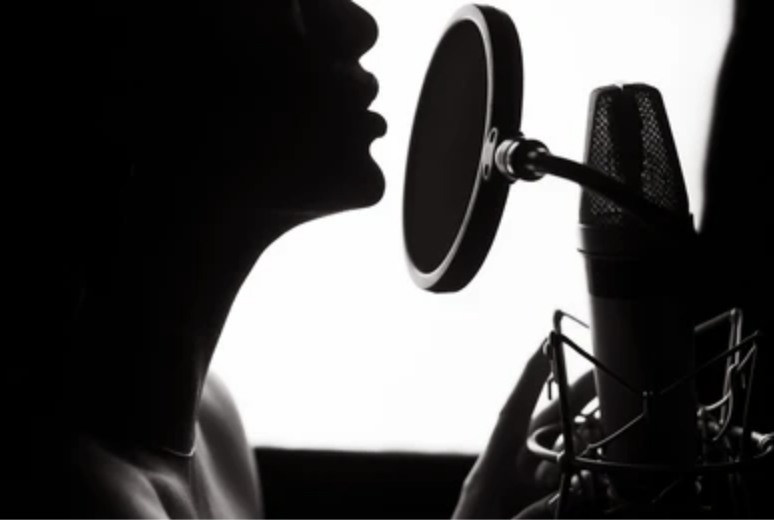
Of course, I’m hoping I’ll get more projects from him, but nothing can compare to the learning curve this experience offered me. Squirreled behind my RODE NT-1 mic and MacBook Air surrounded by the baffles of my sound studio and stopping when I heard sounds of the neighbor mowing his lawn, I had narrated a tale of law enforcement blunders, court scenes, and unbelievable cover-ups that took place over the course of several years. And it was all real.
I am still glowing from the experience. Honestly — I can’t wait for impostor syndrome to push me toward even more challenging projects.